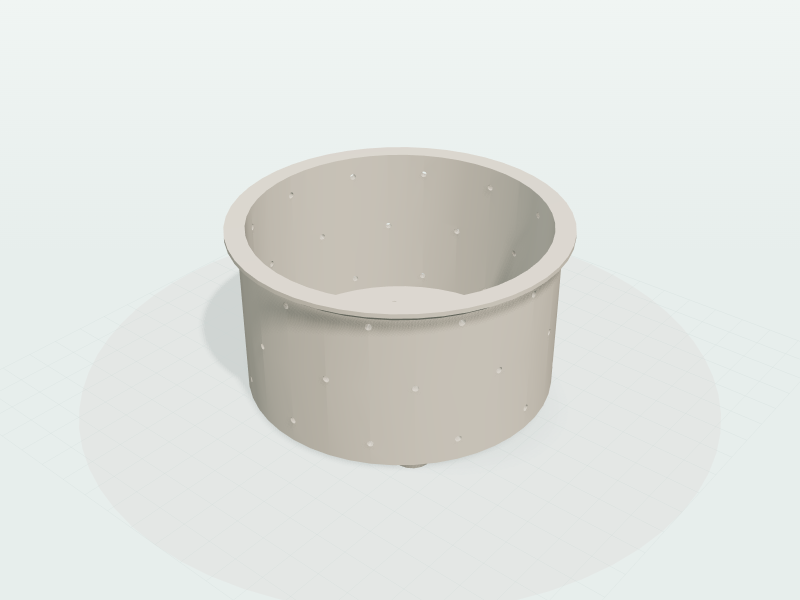
 3D-printed perforated cheese mould with whey drainage holes and matching pressing follower
Diseña moldes de queso imprimibles en 3D con orificios de drenaje y tapa prensadora a medida. Descarga gratuita en 3MF o STL.
Features
- Six artisanal cheesemaking shapes: hard-cheese press cylinder, bottomless soft-rind hoop, tapered slotted basket, truncated pyramid, heart mould and square feta/tofu box
- Optional matching follower lid (flat perforated draining disc or thick bossed press ram) with adjustable fit clearance
- Custom whey-drainage hole or slot patterns plus integrated bottom stand-off feet so whey clears cleanly
- Live curd volume, estimated milk liters required and finished cheese weight readouts
- Support-free flat print orientation on z = 0 with both mould and follower laid side-by-side
What people make with it
- Press semi-hard and hard farmstead cheese wheels with a thick-walled cylinder and bossed follower lid
- Drain fresh ricotta, quark or chèvre in tapered slotted baskets with built-in whey stand-off feet
- Form bloomy-rind soft cheeses inside bottomless perforated hoops
- Make decorative truncated-pyramid goat cheeses or heart-shaped fresh cheeses
- Press square feta blocks, paneer or homemade tofu with a matching square follower
How to use
- Pick a cheese style preset (hard press wheel, ricotta basket, bloomy-rind hoop, pyramid, heart or square feta/tofu box).
- Adjust inner diameter, height, wall thickness and whey drainage hole spacing.
- Enable the matching follower lid if pressing hard cheese, feta or tofu.
- Print in virgin food-grade PETG or PP (0.2 mm layers, 3–4 walls, 30–40% infill for press moulds).
- Line with sanitized cheesecloth/butter muslin before filling with curd, and wash in warm soapy water.
Materials
- PETG: recommended
- ASA: works
- PLA: fit check only — Softens in warm wash water.
Preajustes
Frequently asked questions
Which filament is safest for cheese moulds?
Use undyed, food-contact-certified virgin PETG or polypropylene (PP). Line the mould with cheesecloth or butter muslin during pressing so curd does not pack into FDM layer lines.
How strong is a 3D-printed hard-cheese press mould?
With 3–4 mm walls, 4–5 perimeters and 35–40% gyroid infill in PETG, a press cylinder and bossed follower easily handle home cheesemaking loads (5–20 kg).
Can I wash printed cheese moulds in a dishwasher?
No — standard PETG warps above 70 °C. Sanitize in warm soapy water (under 55 °C) and a food-safe sanitizer solution.
Related generators
For AI agents and developers: API v1, schema.json, index.md. Licencias de código abierto