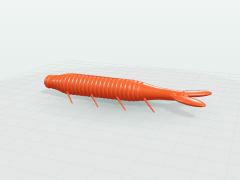
 Creature jig trailer (85 mm) — Gummifisch-Gießform-Generator 3D print model
Erstelle 2-teilige 3D-Druck-Gießformen für Gummifische, Twister, Würmer, Krebse und Frösche. 89 Vorlagen, 3MF & STL direkt im Browser.
Features
- 89 presets in 9 groups — paddle shads, split and fork tails, twisters and grubs, worms, sticks and slugs, creatures and craws, shrimp and insects, frogs, lizards and octopus, saltwater shads — every size adjustable
- Legs with webbed feet, pincer or flapper claws, antennae, twin curl tails and tentacle skirts of up to 16 strands
- Two-part mold with alignment pins, adjustable pin clearance for flash control and a border for clamps or rubber bands
- Open-pour funnel or a hand-injector port with a tapered runner
- Air vents from the tail, paddle, leg and claw tips to the edge of the mold
- 1, 2, 4 or 6 cavities per mold
- Halves exported flat with the cavity facing up — no supports needed
- Ribs, grooves, dimples, bends, eye sockets, hook channel, weedless slot and a shape traced from a photo
- Millimetres or inches in the controls; files are always in millimetres
- Projects you can save and reopen, and links that carry the settings
What people make with it
- Pour your own paddle tail shads, sticks, twisters, craws or grubs in plastisol
- Make a mold for a size or shape you cannot buy
- Copy the outline of a lure you have from a photo
- Print several cavities in one mold for small batches
- Use a hand injector instead of open pouring
How to use
- Pick a lure type.
- Change the length, diameters, tail and details — or keep the tested defaults.
- Check the mold settings: cavities, open pour or injector, pin clearance.
- Press Download model and print both halves in PETG or ASA, cavity side up.
- Clamp the halves together and pour plastisol at about 170 °C.
Materials
- PETG: recommended
- ASA: recommended
- RESIN-HIGH-TEMP: works — Longer mold life.
- PC: works — For experienced FDM users.
- PLA: fit check only — Softens and warps with hot plastisol.
Vorlagen
- Trout micro grub (25 mm) — Tiny ribbed grub with a fluttering curl tail for trout ponds and panfish.
- Streamlined paddle shad (100 mm) — Classic straight-back, curved-belly baitfish with smooth flanks, eye sockets, gill groove, dorsal hook slot and sculpted 3D boot paddle.
- Deep finned notched-tail shad (105 mm) — Tall-bodied compressed baitfish with swept dorsal, ventral and pectoral fins and articulated Kopyto-style notched boot tail.
- Front-ribbed hammer-tail shad (85 mm) — Thick deeply-ribbed front torso tapering into a slender smooth wrist and high-frequency horizontal hammer T-tail for perch and zander.
- Full-ringed swimbait (95 mm) — Deeply ringed soft swimbait with 36 body ribs, dorsal hook slot, pectoral fins and sculpted boot paddle tail for zander and bass.
- Heavy predator shad (150 mm) — Massive 15 cm straight-back predator shad with blunt rigging nose, deep belly, large 3D eye sockets and articulated notched boot tail.
- Predator sickle-tail shad (120 mm) — Substantial 12 cm baitfish body paired with a sweeping vertical predator sickle tail for slow-retrieve pike and zander fishing.
- Ultralight micro shad (55 mm) — Compact 5.5 cm straight-back finesse shad with slim tail wrist and sculpted micro boot tail for perch and trout.
- Vertical fork-tail minnow (110 mm) — Sleek darting baitfish with sculpted swallowtail caudal fin, dorsal and pectoral fins, concave flanks and eye sockets for drop-shot and vertical jigging.
- Finesse pintail slug (110 mm) — Slender tapered pintail with fine body rings and dorsal hook slot for vertical zander and pressured bass.
- Ned rig stick (75 mm) — Compact blunt-ended ringed finesse stick designed to stand upright on a mushroom jig head.
- Stick bait (125 mm) — Nearly constant diameter with blunt ends; a classic 5-inch wacky or Texas-rig stick bait.
- Twister curly tail (70 mm) — Tapered ribbed body with one wide fluttering sickle tail that works at ultra-slow retrieve speeds.
- Ringed perch grub (75 mm) — Fat deeply-ringed grub with a compact curl for perch, bass and panfish.
- Action crawfish (90 mm) — Short broad segmented body with three leg pairs and a wide claw pair on the parting plane.
- Creature jig trailer (85 mm) — Bulky ribbed creature bait with four pairs of fluttering legs, twin swept claws and dorsal hook slot.
- Slim micro shad (47 mm) — Tiny slim shad with a lively boot paddle for perch, trout and ultralight drop-shot.
- Slim jig shad (75 mm) — Narrow-backed shad with a long tail wrist for jigging perch and zander.
- Slim predator shad (140 mm) — Long slender shad for pike and big zander, with a dorsal hook slot for weedless rigging.
- Deep roach shad (100 mm) — Tall compressed roach profile with dorsal and anal fins and a wide boot paddle.
- Big deep roach shad (140 mm) — Large deep-bodied roach imitation with notched boot tail for pike.
- 3D swim shad (90 mm) — Realistic baitfish with eye sockets, gill groove, pectoral fins and flat-sided flanks.
- Giant swim shad (200 mm) — Big-pike swimbait: 20 cm deep belly, large eyes, wide boot paddle. Pour with a plastisol injector.
- Ribbed perch swimmer (76 mm) — Short ribbed swimbait with a dorsal hook slot and boot paddle; the ribs hold scent and push water.
- Slender shiner (100 mm) — Very slim straight shiner with a small high-frequency paddle — subtle action for pressured fish.
- Kicking paddle shad (100 mm) — Thick shad with a large paddle set at a steep angle for a hard kicking roll.
- Flat-sided shad (115 mm) — Rectangular-section shad with flat flanks that flash on the fall.
- Short-wrist shad (90 mm) — Flat-sided compact shad with a short thick wrist and an oversized heavy paddle — casts far; pour the tail in a contrast colour.
- Belly-ribbed shad (100 mm) — Smooth-backed shad with ribs only on the belly for extra vibration.
- Dense micro shad (70 mm) — Chunky short shad with a capsule cavity for a tungsten bead or rattle.
- Soft natural swimbait (150 mm) — Natural swimbait with fins, eye sockets and a big boot — pike and big zander.
- Side-fin glider shad (100 mm) — Shad with long flapping side fins behind the head plus a boot paddle — vibrates even when paused.
- V-tail slim shad (145 mm) — Long slim body ending in two thin V blades that shiver at slow retrieve speeds.
- Split-tail minnow (127 mm) — Slender minnow with a forked V tail for drop-shot and twitching.
- Fork-tail swim shad (180 mm) — Large natural baitfish with a swept swallowtail fin for pike jerking and slow rolling.
- Soft jerk fluke (110 mm) — Torpedo jerkbait with a belly hook slot area, flat sides and a small forked tail — darts side to side.
- Micro dart minnow (56 mm) — Small fork-tailed minnow for perch and trout on light jigs.
- Micro rockfish (36 mm) — Tiny chunky fish with big pectoral fins and a forked tail — light rockfishing and perch.
- Ribbed long-curl twister (85 mm) — Slim ribbed body with a long sickle curl that swims at the slowest retrieve.
- Fat curl grub (100 mm) — Chunky ringed grub with a wide curl tail — a classic jig head bait.
- Pin-curl trout grub (53 mm) — Small slim grub with a thin tight curl for trout on micro jigs.
- Double-curl grub (80 mm) — Ribbed grub with two curl tails that kick in opposite directions.
- Curl-tail finesse worm (64 mm) — Thin ringed worm with a small curl tail for drop-shot and split-shot rigs.
- Ribbon-tail worm (120 mm + tail) — Long Texas-rig worm with a very long thin ribbon tail.
- Ribbed leech with curl (50 mm) — Slim fully-ribbed leech body with a long thin curl — perch and trout.
- Fat ringed curl worm (150 mm) — Thick fully-ringed worm with a big curl tail for bass and pike.
- Side-ribbed tadpole (74 mm) — Worm-like body with a thick ribbed front, side ribs and a tiny paddle — rocks side to side on a slow drop.
- Pike tadpole (147 mm) — Big version of the side-ribbed tadpole for pike — the thick front rocks the whole body.
- Nano drumstick (25 mm) — Tiny drumstick-shaped bait: fat round front, thin stem and a micro paddle — nano jigging, summer and ice.
- Straight finesse worm (63 mm) — Slim smooth worm with a soft taper — the classic drop-shot and Texas finesse worm.
- Tapered drop-shot worm (78 mm) — Fat ringed front half tapering to a thin flicking pin tail.
- Trout ribbed worm (50 mm) — Small fully-ringed worm for trout and panfish.
- Salty pin worm (50 mm) — Short ringed worm with a fine pin tail — pour it with salt for a slow natural fall.
- Earthworm finesse (100 mm) — Thin natural earthworm with fine rings and a raised saddle band.
- Bristle lugworm (115 mm) — Segmented sea worm with fine bristles along both sides — bottom rigs and flatfish.
- Sand ragworm (100 mm) — Flat ragworm with many paddle-like side legs.
- Fat ringed worm (150 mm) — Thick fully-ringed straight worm for Texas and Carolina rigs.
- Eel slug (89 mm) — Long eel-like slug with a flat-sided tail that swims with a snaking motion.
- Big pintail slug (180 mm) — Large slug with a thin flicking pin tail and dorsal hook slot — vertical pike and zander.
- Ribbed finesse stick (70 mm) — Short blunt stick fully covered with soft rings — Ned rig and wacky.
- Shaker stick worm (115 mm) — Thick stick bait with rings at both ends — shakes on a jighead, falls slowly wacky-rigged.
- Glide pintail (100 mm) — Baitfish front with a long thin pin tail — glides and flutters on the drop.
- Dart stick (125 mm) — Slim dart-shaped slug with a diamond cross-section and pin tail for darting retrieves.
- Fin-ribbed slug (76 mm) — Tall-sided slug with deep sharp rings recessed into the flanks — the ribs flex and radiate vibration at slow speed.
- Micro hog (40 mm) — Tiny creature with legs and twin claws for micro jigs and drop-shot.
- Four-tentacle hog (63 mm) — Long ribbed hog ending in four soft tentacles that vibrate on every move — flipping, Texas and jig trailer.
- Flapper jig trailer (50 mm) — Short trailer with two big flat flapper arms that kick on the fall.
- Rock craw (50 mm) — Small crayfish with big pincers at the tail end and walking legs — rigged nose-first like a fleeing craw.
- Slim creature craw (55 mm) — Narrow ribbed craw with thin legs and slim pincers for finesse jigs.
- Alien bug (38 mm) — Small bulky bug with legs all around and a tentacle tail — odd but deadly for perch.
- Flapper creature (70 mm) — Creature bait with ribbed body, side legs and two wide flapper arms.
- Big flapper craw (90 mm) — Large craw with wide flapper claws and a weedless back slot for punching heavy cover.
- Spider skirt (75 mm) — Bulky head with a skirt of thin tentacle legs — a soft swim-jig trailer that breathes in the water.
- Ribbed vibe hog (64 mm) — Ringed hog with short legs and a small flat paddle tail.
- Ribbed shrimp (76 mm) — Curved segmented shrimp with walking legs, long antennae and a fan tail.
- Curl-tail shrimp (76 mm) — Shrimp body with legs and feelers plus two curl tails for constant action.
- Insect nymph (71 mm) — Nymph with six legs, short antennae and twin pin tails.
- Twin-curl bug (64 mm) — Bug body with legs and two curl tails that kick to both sides.
- Segmented larva (90 mm) — Plump larva with segment rings, four pairs of short legs and a three-strand tail.
- Trout maggot (25 mm) — Tiny segmented maggot for trout and float fishing — pour many cavities at once.
- Soft frog (50 mm) — Small frog with a flat body, big eyes and two kicking legs with webbed feet.
- Swimming frog (100 mm) — Big swim frog with a weedless back slot and long legs with paddle feet.
- Flapper frog (90 mm) — Frog body with two wide flapper legs that slap the surface — buzz it over weeds for pike and bass.
- Twin-curl frog (90 mm) — Frog body with two long curl legs that churn on a steady retrieve.
- Swimming lizard (150 mm) — Lizard with four legs and a long curl tail for Carolina rigs.
- Octopus skirt (90 mm) — Round head with a skirt of eight tentacles — inline spinner skirts, jig heads and sea rigs.
- Pollack shad (125 mm) — Heavy-bodied saltwater shad with a thick wrist and large paddle for pollack, cod and sea bass.
- Cod shad (150 mm) — Big saltwater shad for deep jigging: thick body, hook channel, notched boot tail.
- Pre-rig baitfish (200 mm) — Large natural baitfish with a hook channel through the body for wire or through-rigs.
Frequently asked questions
Is it free?
Yes. Every lure type and mold feature is free, with no account. A short page with recommended materials may be shown before a download.
What file do I get?
A 3MF (or STL files in a zip) in millimetres with both mold halves lying flat, cavity up, plus a README with material and safety notes and your settings (parameters.json).
What should I print the mold in?
PETG or ASA on an FDM printer, or a high-temperature resin for a longer life. PC works for experienced users. PLA is only good for a fit check: it warps with hot plastisol. A printed mold lasts dozens of pours, not production runs.
Is pouring plastisol safe?
Plastisol is poured at about 170 °C. Keep the mold, tools and colourants completely dry (water in hot plastisol spatters), work with ventilation, and wear eye protection and heat-resistant gloves.
Can I use a hand injector?
Yes. Choose “Hand injector” and the mold gets a port for the nozzle with a tapered runner into the cavity and vents at the far end.
Are my designs uploaded?
No. The geometry is computed in your browser; settings and photos stay on your device.
For AI agents and developers: API v1, schema.json, index.md. Open-Source-Lizenzen